
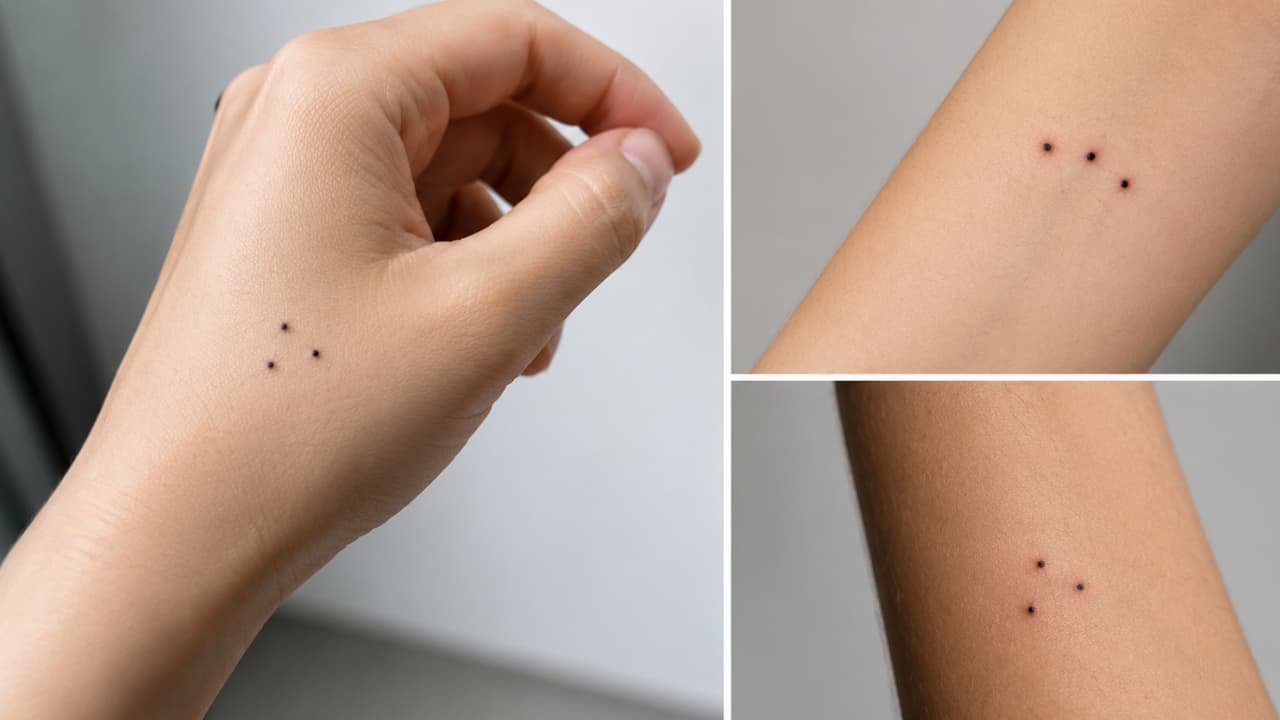
Three Dot Tattoo Meaning: What This Tiny Symbol Really Represents
Scroll through enough tattoo inspiration boards and you’ll eventually stumble on it: three small dots, usually arranged in a simple line or triangle, tucked onto a wrist, a hand, or just below an eye. It’s understated. It’s easy to miss. And yet almost no other minimalist tattoo sparks as many questions as this one.
Part of the intrigue comes from a persistent rumor that circulates on social media — the idea that three dots automatically signal something dangerous or forbidden. That claim gets repeated so often that a lot of people genuinely believe it’s the only explanation. In reality, the three dot tattoo meaning is far broader, and far more personal, than any single storyline suggests.
If you’re thinking about getting this design, trying to understand a tattoo you already have, or simply curious after seeing it on someone else, this guide breaks down where the symbol comes from, what it can represent, and why it’s impossible to read a tattoo without knowing the person behind it.
Where the Three Dot Tattoo Came From
Tracing the exact origin of the three dot tattoo is tricky, because different communities have adopted it independently over the decades, each attaching their own meaning to it. That’s actually part of what makes minimalist symbols like this so interesting — a design doesn’t need words to communicate; it just needs enough emotional weight for the wearer to remember why they chose it.
One of the most widely referenced associations is the Spanish expression mi vida loca, meaning “my crazy life.” This phrase became linked to the tattoo through pop culture and, in certain contexts, through specific subcultures. But treating that as the definitive answer misses the bigger picture. Plenty of people ink three dots with zero knowledge of that phrase at all, drawn instead to the shape itself or to a completely different personal story.
The Most Common Interpretations Today
A Symbol of Family and Connection
For a huge number of people, three dots simply stand for the people they love most. It’s a favorite choice for parents who want a subtle nod to their children, or for someone honoring three siblings, three close friends, or three generations of their family. Because the design is so compact, it works well as a first tattoo or as a quiet addition alongside other body art.
A Reminder of Personal Growth
Another popular reading ties the three dots to a personal journey — often expressed as past, present, and future, or as mind, body, and spirit. People recovering from a difficult chapter in life, whether that’s illness, addiction recovery, grief, or simply a hard year, sometimes choose this tattoo as a private marker of how far they’ve come.
What Actually Changes When a Married Woman Feels Drawn to Someone Else
Spiritual and Religious Symbolism
The number three carries deep meaning across many belief systems, and tattoo art has borrowed from that tradition for generations. Depending on someone’s faith, the three dots might reference the Holy Trinity, the balance of faith, hope, and love, or broader ideas like birth, life, and death. For minimalist tattoo lovers, this is an appealing way to express a spiritual value without needing elaborate imagery.
Pure Aesthetic Choice
It’s also worth saying plainly: sometimes three dots are just three dots. Minimalist tattoos have exploded in popularity precisely because they don’t require an elaborate backstory. Small geometric shapes, simple lines, and understated symbols have become a design category of their own, chosen purely because they look clean and versatile on the skin.
Addressing the Gang Association Directly
It would be misleading to write about this topic and ignore the association some people have heard about. In certain regions, law enforcement has documented cases where the three dot tattoo appeared among individuals connected to gang activity, often placed near the eye or on the hand.
That said, tattoo researchers and criminologists are consistent on one point: a tattoo alone is never proof of anything. Investigators who study these symbols look at a much wider set of factors — the tattoo’s exact placement, whether it’s paired with other specific markings, a person’s documented history, and behavioral patterns — before drawing any conclusions. A single design, on its own, tells you almost nothing reliable about the person wearing it.
Two strangers could have the exact same three dots inked in the exact same spot, and their reasons could be worlds apart. One might be marking three children. The other might simply like the aesthetic. Assuming the worst based on a tiny symbol says more about the assumption than the tattoo itself.
Why Snap Judgments About Tattoos Are Risky
Beyond this specific design, there’s a broader lesson here about how we interpret body art in general. Jumping to conclusions about someone because of a tattoo can lead to real consequences — awkward social interactions, unfair assumptions in professional settings, or outright discrimination. Tattoos are a form of self-expression, not a public résumé of someone’s character.
If you’re genuinely curious about a tattoo you’ve noticed on a friend, coworker, or even a stranger, the simplest and most respectful approach is to ask. Most people who choose meaningful tattoos are happy to share the story behind them, and a short, polite conversation will tell you far more than any assumption ever could.
Popular Placements and What They Might Suggest
While placement doesn’t change the underlying meaning of the tattoo, it can influence how visible and personal it feels to the wearer.
- Wrist or hand: A popular spot for reminders people want to see throughout the day, often tied to personal growth or family.
- Behind the ear or on the ankle: Common for those who prefer a more private, easily hidden design.
- Near the eye: Historically the placement most associated with subculture symbolism, though today it’s also chosen simply for its bold, minimalist look.
- Forearm or shoulder: Frequently paired with other small tattoos to build a larger, personalized collection over time.
Tips If You’re Considering This Tattoo
If the three dot design has caught your eye and you’re thinking about getting it yourself, a few practical tips can help you make a decision you’ll feel good about long-term.
- Get clear on your own meaning first. Whether it’s family, resilience, faith, or simply style, having your own reason ready will matter more to you than any outside interpretation.
- Choose placement thoughtfully. Consider workplace norms, visibility, and how the location might be perceived, especially given the symbol’s varied associations.
- Talk to an experienced tattoo artist. A skilled artist can help with spacing and proportion so the dots look intentional rather than accidental.
- Don’t feel pressured by internet rumors. A viral claim about a tattoo’s “true meaning” doesn’t override your own personal reason for choosing it.
The three dot tattoo is a perfect example of how much meaning a simple design can hold — and how much that meaning depends entirely on the person wearing it. For some, it’s a quiet tribute to family. For others, it marks a personal turning point, a spiritual belief, or nothing more than an appreciation for clean, minimalist art. While the design has been associated with certain subcultures in specific circumstances, that’s only one small piece of a much larger picture.
The next time you see someone with three dots inked on their skin, resist the urge to assume you already know the story. Ask, listen, and you might find the meaning is more personal — and more meaningful — than you expected.
Does a three dot tattoo always represent gang involvement? No. While it has appeared in some documented gang-related cases, the vast majority of people who choose this tattoo do so for personal reasons like family, spirituality, or simple aesthetic appeal.
What is the most common meaning behind three dots? There isn’t one universal meaning. Family connections, personal growth, spiritual beliefs, and minimalist style are all common interpretations, and the “correct” one depends entirely on the individual.
Is the three dot tattoo a good choice for a first tattoo? Yes, many people choose it as a first tattoo because it’s small, relatively low-pain to get, and easy to place discreetly if desired.
Where is the three dot tattoo usually placed? Popular spots include the wrist, hand, behind the ear, and ankle, though it can be placed almost anywhere depending on personal preference.
Should I ask someone about the meaning of their tattoo? If done respectfully, yes. Most people are happy to explain the personal story behind a tattoo, and it’s a far more reliable way to understand its meaning than making assumptions.